

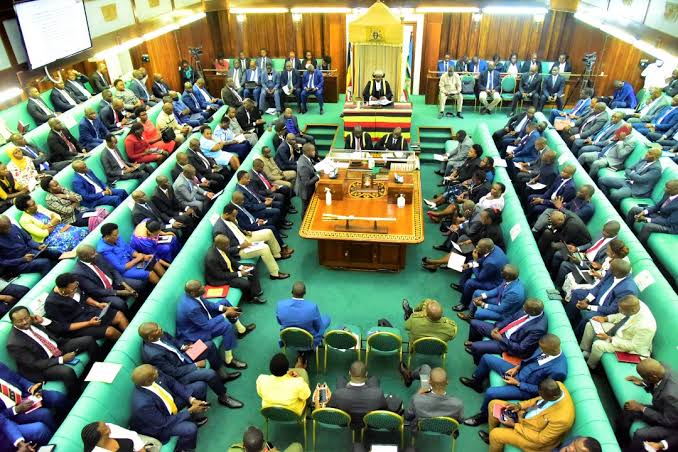
Parliament Passes Controversial protection of Sovereignty Bill under heavy Security watch.
Kampala: Uganda’s Parliament on Tuesday May 5, 2026 passed the Protection of Sovereignty Bill, 2026 under tight military and police security, after a heated sitting that exposed deep divisions over how far the State should go in regulating foreign influence.
The Bill was passed after Parliament adopted the report of the joint committee on Defence and Internal Affairs and Legal and Parliamentary Affairs, completed clause by clause consideration, and read the Bill for the third time.
Speaker Anita Among earlier confirmed quorum, saying 353 MPs were present, including eight attending by Zoom, before the House moved into Committee Stage.
The committee said it handled submissions from 224 stakeholders clustered under 60 groups, including the Bank of Uganda, Uganda Law Society, business groups, political parties, religious bodies, universities, health researchers, diaspora representatives, the UN and civil society organisations.
Power
Across the submissions, the committee said there was broad agreement that “the Bill’s objective is legitimate, but its definitions and application are overly broad,” that it duplicates existing laws, concentrates “excess power” in the Minister and that its impact “could extend the entire economy.”
The committee said Clause 2 was central because it “defines the reach of the law and determines who is regulated, under what circumstances, and for what conduct.”
It noted that while the Attorney General viewed the clause as narrow, “stakeholders consistently note that this limitation is not clearly reflected in the drafting.”
The committee concluded that “the line between harmful foreign interference and legitimate activities is unclear.”
The sitting was marked by procedural tension after Nakawa West MP Joel Ssenyonyi raised concern over the handling of the minority report during Committee Stage.
Ssenyonyi cited Rule 215(2) of Parliament’s Rules of Procedure and questioned why members presenting the minority report, including Jonathan Odur, were given less time than those advancing the majority position.
He asked whether the Speaker was declining to entertain minority views and whether dissenting arguments were being treated as irrelevant.
The House nevertheless proceeded to Committee Stage and later passed the Bill.
Key amendments now narrow the Bill to “agents of foreigners,” excluding Ugandans living abroad from the definition of foreigners.
An agent of a foreigner is now defined as a person acting for, under the direction of, or financed by a foreigner while engaging in activities covered by the law.
The Bill, however, retains a broad definition of “political activities,” including actions aimed at influencing legislation, policy, government decision making, elections, who governs Uganda, and ideologies seen as inconsistent with the Constitution or cultural norms.
To address concerns raised by President Museveni, the Bank of Uganda, Buganda and the World Bank, Parliament inserted safeguards stating that the law shall not restrict lawful foreign direct investment, portfolio investment, diaspora remittances, export proceeds, trade finance, commercial loans, humanitarian assistance, grants, concessional financing and development assistance.
The committee said this was necessary because financial sector stakeholders had warned that approval based controls could cause “system wide stress” affecting “financial flows, investment, and key economic infrastructure.”
Jail
On penalties, the committee said the proposed 20 year jail terms were “disproportionate,” reducing several offences to a maximum of 10 years and requiring intent.
The offence of economic sabotage was redrafted to target agents of foreigners who knowingly publish false information or engage in acts intended to damage Uganda’s economic system.
The committee said vague offences risked a “chilling effect,” where “advocacy, research, journalism, or business operations may be discouraged.”
The report also acknowledged the clash between the Finance Ministry and Bank of Uganda. It said the Finance certificate treated the Bill as costing Shs 29.029 billion, but BoU viewed it as a possible “macro financial shock.”
The committee concluded that although the certificate was “technically compliant,” it failed to capture broader risks to “financial sector stability, capital flows, and monetary policy effectiveness.”
The Bill now awaits presidential assent to turn into a law.
Tags: Countryradio, Police, Rukungiri, Uganda